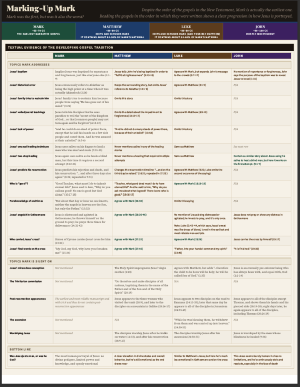
Marking-Up Mark
Mark was the first gospel written. But it doesn’t contain a birth story, or the Sermon on the Mount, or Jesus’ post-resurrection appearances, so how could it possibly be the oldest one? Here we’ll show that Mark was not only the first, it’s also the cornerstone of the entire gospel tradition.
Did Mark actually write the Gospel of Mark?
- All of the gospels, including Mark, were written anonymously. None of them claim to have been written by a specific named person.
- As the gospels began circulating as a group in the second century, the early church fathers eventually assigned names to each of them, mainly for the purpose of differentiation.
Why is Matthew the first book in the New Testament?
- The early church fathers thought the Gospel of Matthew was the earliest one, so most Bibles throughout time have held to that tradition.
- Most scholars date the Gospel of Mark to around the year 70.
- Matthew and Luke were probably written between the years 80 and 90.
- John was probably written in the 90s or a little later.
Did Matthew or Luke use Mark's gospel as a source?
- The literary relationship between Mark, Matthew, and Luke is virtually indisputable.
- Collectively, these three are known as the Synoptic Gospels (synoptic means "seeing together") because they have so much material in common.
- 80-90% of Mark's gospel is the Gospel of Matthew.
- 50-60% of Mark's material is the Gospel of Luke.
- In both Matthew and Luke, material from Mark often appears word-for-word, and sometimes even entire paragraphs are the same.
Why does any of this matter?
- Placing Mark first and John last shows a clear progression in how Jesus is portrayed:
- In Mark's gospel, Jesus' humanity is on full display. He has limitations in both power and knowledge, and he dies in anguish and despair.
- Matthew and Luke introduce Jesus' divinity through their birth stories, and also remove most of his limitations. Most scholars place Matthew before Luke, and some think Matthew was a source for Luke.
- In John's gospel, Jesus seems barely human. He has no limitations, and he's continuously stoic and resolute, especially in the face of death.
- This progression is obscured by the New Testament's transposition of Mark and Matthew.
Bottom line: Reading the gospels in the likely chronological order of their composition shows how they transformed Jesus from a man into God.
See more in the PDF, and add your comments below.
Note: Posting a comment requires a free account on our hosting service, GitHub.com. It’s a safe, well-known website owned by Microsoft, and you can sign up instantly using your existing Google or Apple account.